


How Loan Prepayments Can Reduce Interest and Shorten Your Loan Term

Making an additional payment towards a loan can reduce the outstanding principal and potentially generate meaningful interest savings.
However, the exact effect depends on:
The amount prepaid
The timing of the payment
The remaining loan balance
The interest rate
The remaining loan term
Whether repayments are recalculated
Any lender prepayment charges
A loan prepayment calculator can help compare the original loan with the revised repayment scenario before a payment is made.
What is a Loan Prepayment?
A loan prepayment is an additional payment made towards the outstanding loan balance outside the normal repayment schedule. It may take the form of:
A one-off lump-sum payment
Regular additional repayments
A partial loan settlement
Full early repayment
A payment made after receiving excess cash or selling an asset
The additional amount is normally applied against principal, reducing the balance on which future interest is calculated.
Why Can a Prepayment Reduce Interest?
Interest is generally calculated based on the outstanding loan balance. When a borrower makes a prepayment, the balance falls earlier than originally expected. As a result, future interest is calculated on a lower amount.
The earlier the payment is made, the greater the potential interest saving, assuming there are no offsetting fees or penalties. A prepayment made near the start of a loan will usually save more interest than the same payment made close to maturity.
What can Happen after a Prepayment?
Depending on the loan agreement and the borrower’s objective, a prepayment can be handled in different ways.
Reduce the Remaining Loan Term
The borrower continues making approximately the same periodic repayment, but the loan is repaid earlier. This option will often maximise interest savings because the debt remains outstanding for a shorter period.
Reduce Future Repayments
The remaining loan term stays broadly the same, but the periodic repayment is recalculated based on the reduced balance. This option may improve monthly cash flow, although the interest saving may be lower than when the term is shortened.
Reduce the Final Payment - Some arrangements leave the regular repayments unchanged and reduce the amount due at maturity. The treatment depends on the lender’s terms and repayment calculation method.
Example Calculation
Original Loan
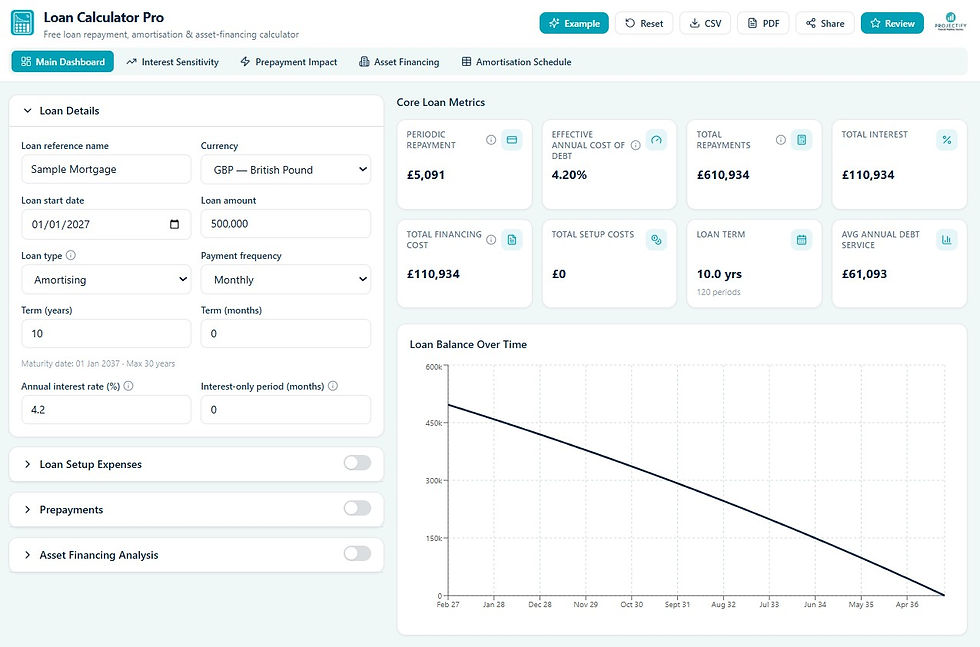
Loan amount: £500,000
Loan start date: 01 Jan 2027
Interest rate: 4.2%
Loan term: 10 years
Repayment frequency: Monthly
Original monthly repayment: £5,091
Original total interest: £110,934
Original maturity date: 01 Jan 2037
Prepayment Scenario 1 - Reduced Repayment
Assumptions:
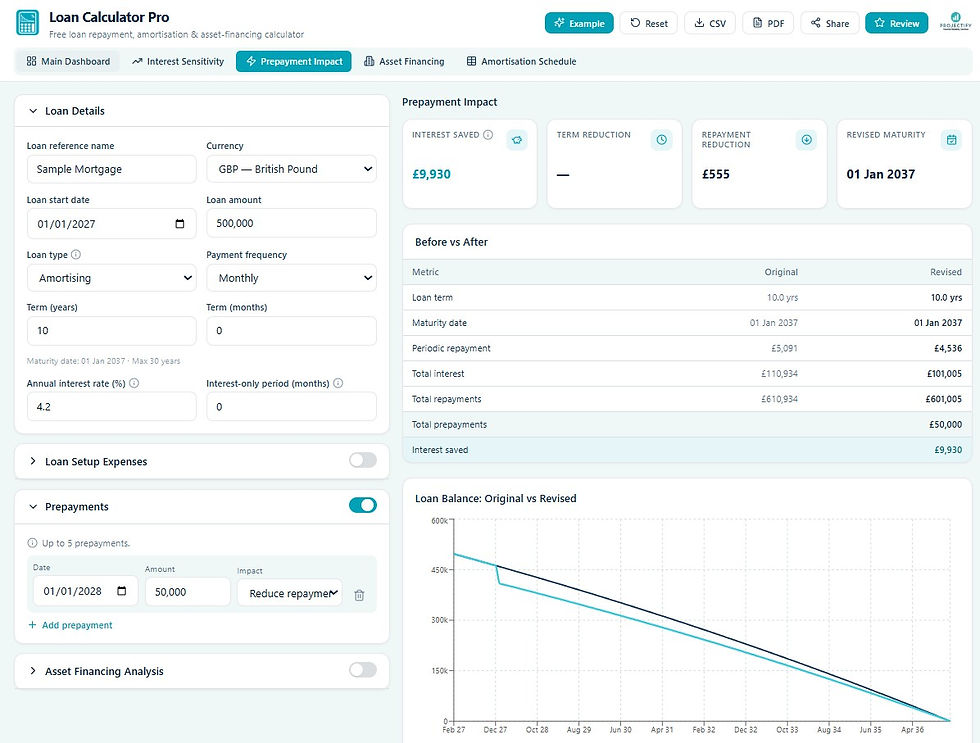
Prepayment amount: £50,000
Prepayment date or period: 01 Jan 2028
Treatment: reduce repayment
Revised Results:
Revised repayment: £4,536
Revised total interest: £101,005
Total Interest saved: £9,930
Revised loan term: N/A
Months or years saved: N/A
Revised maturity date: N/A - still 01 Jan 2037
Prepayment Scenario 2 - Reduced Term
Assumptions:
Prepayment amount: £50,000
Prepayment date or period: 01 Jan 2028
Treatment: reduce term
Revised Results:
Revised repayment: N/A - still £5,091
Revised total interest: £90,120
Total Interest saved: £20,815
Revised loan term: 8.9 years
Months or years saved: 1.1 years
Revised maturity date: 01 Dec 2035

Should you Reduce the Repayment or Shorten the Term?
From the above examples we can see that reducing the loan term whilst keeping repayment the same results in a higher total interest saving than reducing the loan repayment. This is because the borrower is postponing the benefit to the end of the loan term rather than spreading it monthly by reducing the repayment amount. This analysis however doesn't factor in the impact of inflation.
In practice, the best option depends on the borrower’s priorities:
Shortening the loan term may be suitable when:
The borrower wants to become debt-free sooner
Existing repayments remain affordable
Maximising interest savings is the main objective
There is sufficient cash available after the prepayment
The borrower expects stable income or cash flow
Reducing the repayment may be suitable when:
Monthly affordability is the priority
The borrower wants to improve cash flow
Income or business cash flow is uncertain
The borrower wants to retain a longer repayment period
Lower future debt service is strategically valuable
For a business, reducing annual debt service may improve liquidity and create additional capacity for investment or working capital.
When is a Loan Prepayment Most Effective?
A prepayment tends to have a greater impact when:
It is made early in the loan term
The loan has a relatively high interest rate
The outstanding balance remains substantial
The remaining term is long
The lender does not charge a material penalty
The payment is applied directly against principal
The benefit may be less significant where:
The loan is close to maturity
The interest rate is very low
Prepayment fees are high
The payment materially reduces available emergency cash
The borrower has alternative debts with higher interest rates
Aspects to Consider Before Making a Prepayment
Check for Early Repayment Charges
Before making a prepayment, review the loan agreement for:
Early repayment penalties
Break costs
Fixed-rate termination charges
Minimum prepayment amounts
Annual prepayment limits
Notice requirements
Administrative fees
Consider Liquidity Before using Available Cash
Paying down debt may improve the balance sheet and reduce financing costs. However, it also reduces available cash. Before making a large prepayment, consider whether the funds may be needed for:
Emergency reserves
Working capital
Taxes
Capital expenditure
Business expansion
Property maintenance
Other higher-return investments
More expensive debt
A prepayment should therefore be assessed alongside the borrower’s wider financial position.
Can Several Prepayments be Modelled?
Some borrowers make multiple additional payments rather than one large lump sum.
For example:
An annual bonus
Quarterly surplus cash
Proceeds from asset disposals
Seasonal business cash surpluses
Regular mortgage overpayments
Loan Calculator Pro allows users to model multiple prepayment scenarios and see how each payment affects the outstanding balance.

Use Loan Calculator Pro Prepayment Calculator
Loan Calculator Pro allows users to compare an original loan against a revised prepayment scenario.
The analysis can show:
Interest savings
Changes in periodic repayments
Changes in annual debt service
Reduction in the remaining loan term
Revised maturity date
Original and revised loan balances
Period-by-period amortisation
Analyse a prepayment scenario here:
Disclaimer :The treatment of prepayments varies by lender and loan agreement. Loan Calculator Pro provides illustrative calculations and does not account for every lender fee, contractual restriction or tax consequence. It does not constitute financial, legal, accounting, investment or tax advice.

Comments